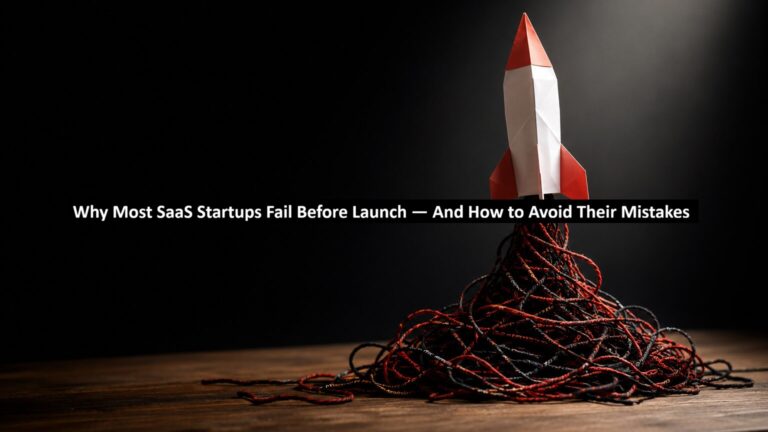
The deadliest place for a SaaS founder isn’t a full market or a bunch of cutthroat competitors; it is their own development environment.
Every year thousands of entrepreneurs go off into digital caves and try to create the “next big thing.” They spend months (sometimes years) creating their code and building their architecture for a million users they don’t have yet. Then they hit the “Launch” button, and crickets. Or even worse, the product never makes it to the public and instead goes to “Code Heaven.”
The reality is brutal: According to conventional wisdom, — 90% of startups fail — but an even higher number of SaaS Companies go bust before they get their first customer. Most fail for either developing the wrong solution or building over-engineered solutions for a market that doesn’t exist.
If you want your software product to survive, you must understand the main reasons why SaaS startups fail and restructure your plan before you write the first line of code.
Read: What are The Distinctive Sorts of Portable Apps?
1. Chasing the “Market Need” Mirage
When CB Insights conducted a major study of startup failure, 35% of respondents indicated that their primary reason for failure was a lack of market need. In SaaS, this type of failure can be described as a “Market Need Mirage.” Founders mistakenly use technology as the basis for their decision-making instead of understanding customer pain points and what solutions they would be willing to pay for.
Is Your SaaS a Vitamin or a Painkiller?
It’s essential to differentiate between the two types of products that can fit your market when seeking product/market fit:
- Vitamins – a nice-to-have, product/service feature that very slightly enhances an already existing process;
- Painkillers – a solution to one (or more) urgent problems (“bleeding”) that have an immediate and long-term financial impact on the company (both in time and $).
When trying to validate prior to launch (build & ship), you are liable to get “complimentary validation.” In this case, if you ask a friend if your product/service is “nice,” he/she will say “yes” just to make you feel good. The best way to validate your product/service as a real SaaS offering is to have someone who would be a potential customer make a commitment to you by providing their time, their data, or placing a deposit/preorder.
2. The Perfectionist’s Paradox: Over-Engineering the MVP
Many founders in SaaS tend to make the common mistake of being trapped in the “just one more feature” mentality when developing their MVP. For example, founders will attempt to hide their fear of “failure” with perfectionism, believing that if they could just add one more integration or make the dashboard more modern, their product would finally be “ready.”
Beware of Technical Vanity
Vanity of creation is the practice of designing for an audience that has not yet been established.
Although you could hire a professional SaaS product development company (for instance, here are some), to create a repository where all these microservices could reside (without having completed an MVP or having 10 customers), this is usually ineffective use of funds.
One of the greatest quotes from Reid Hoffman (founder of LinkedIn) states, “If you’re embarrassed by the first version of what you’ve created, you’ve taken too long to finish it.” Therefore, if you forget about the “Minimum” aspect of Minimum Viable Products, you run the risk of building a “Maximal” product that may never sell!
3. The “Stealth Mode” Delusion
One of the common misconceptions in the startup world is that you shouldn’t share your SaaS concept with others, out of fear that they will steal your idea, thus creating the Stealth Mode Delusion. Instead of worrying about someone taking your idea, your primary concern should be creating an audience for your product.
The most effective way to prepare for the launch of your new SaaS company is to build your product while sharing your journey with the public. If you don’t begin marketing your SaaS until launch day, you are already 6 months too late. Many SaaS that fail before launch don’t have any kind of audience or feedback loops (to get input from potential customers). Unfortunately, when they finally figure out their user interface (UI) is not intuitive and that their primary functionality is provided by a competitor, they have also exhausted their financial resources.
4. Premature Scaling: The Ultimate Budget Killer
The Startup Genome Report found that 74% of high-growth startups fail due to premature scaling. This is a primary driver of financial collapse in the SaaS sector.
You are scaling prematurely if you:
- Hire a full sales team before you have a repeatable sales process.
- Spend heavily on PR and “brand awareness” before the product is stable.
- Hire specialized developers for features that haven’t been validated by users.
Every dollar spent on scaling a product that hasn’t found its footing is a dollar closer to the end of your “runway.”
5. The Survival Framework: 5 Steps to a Successful Launch
In order to avoid creating a “Code Cemetery”, we need to develop a SaaS validation framework that places more emphasis on customer satisfaction than founder ego. The following five steps will help ensure that your product is able to reach the finish line:
- Conduct a “Smoke Test”: Create a minimalist landing page to explain your value proposition (how your product provides value to customers). If you are unable to acquire visitors who click the “Join Waitlist” button after spending a few dollars on digital advertisements, then they aren’t going to buy your SaaS solution either.
- The 10-Customer Rule: Do not create any backend code until you have interviewed 10 potential customers who agree that the problem you are trying to solve is one of their top 3 business priorities.
- Concierge MVP: First, solve the problem manually. If you are building an automated reporting tool, generate the report by hand for the client. If they would like to pay for the automated solution after seeing the benefit of the manual process, that’s a good signal that there is customer demand for your product(s).
- Time-Box Your Build: Allow yourself a “Drop Dead” date (i.e. 60 days). If you haven’t been able to launch the core value proposition of your product(s) within that time frame then the scope of your project may be too large.
- Identify your North Star Metric: Identify the one feature that will create the “Aha!” moment for your customer and focus upon that feature, not “Dark Mode”, “Profile Picture” etc.
Case Studies: Learning from Quibi and Dropbox
There are two ends to the spectrum when it comes to defining the evolution of SaaS:
- Quibi (the Failure): Quibi raised $1.75 billion and built a cutting edge platform with zero validation from potential customers that they really wanted “quick-biting” mobile content. After scaling this nonexistent desire into an additional 15 million users, they closed only a few months later.
- Dropbox (the Success): Before creating an elaborate file-synchronizing platform with his team, founder Drew Houston produced a 3-minute demonstration video of how it would operate. Within 24 hours of this release, his waiting list grew from 5,000 to 75,000 users. Validation came first, then the heavy coding necessary for their platform.
Conclusion
The majority of SaaS startups fail due to out-of-date thinking that treats launch as completing the development of their service. In fact, your launch serves as the commencement of your partnership with your use base.
If you want to succeed, then have the courage to launch your first product when it is still imperfect, and have the humility to sincerely listen and act upon the feedback you receive from your initial users. The only way to have you remain alive as a startup company, is to launch your product as quickly as possible, and then continue to grow and improve on it at a measured pace while steadily focusing on solving a specific pain point (customer need) with no intention of ever getting buried in the “Code Cemetery”.
Author Bio:
Akshay Tyagi is a content writer at NetClubbed, a leading provider of SaaS product development services. He excels at translating complex technical concepts into clear, actionable strategies that help brands refine their voice and achieve measurable results
